

America’s Road: How the Natchez Trace Helped Shape 250 Years of a Nation
America’s Road: How the Natchez Trace Helped Shape 250 Years of a Nation America turns 250 this year. There will be fireworks, parades, and plenty of celebrations from coast to coast. But if you really want to feel the weight and wonder of this country’s history beneath your feet, there’s one place you need to be: the Natchez Trace Parkway.
This isn’t a museum. It’s not a re-enactment. It’s 444 miles of living history stretching from Natchez, Mississippi, to Nashville, Tennessee – and it has been carrying the American story longer than the nation itself has existed.
The Natchez Trace Parkway isn’t just a beautiful drive. It’s one of America’s most historic roads.
A Path 10,000 Years in the Making
Long before there was a United States, there was the Trace. For thousands of years, Indigenous peoples – including the Natchez, Chickasaw, and Choctaw nations – traveled and traded along this ancient corridor. These weren’t simply footpaths. They formed part of an extensive network of travel, trade, diplomacy, and cultural exchange across the Southeast.
The Trace was already ancient when the first European explorers arrived, and the communities that built it shaped this landscape in ways still visible today. As America turns 250, it’s worth remembering that this road’s story stretches back 10,000 years – a reminder that this land has always been a place of movement, meeting, and meaning.
From Ancient Paths to American History
The Trace has witnessed every chapter of this country’s story. Indigenous nations built and traveled it for millennia before European explorers ever arrived. After the Revolution, frontier boatmen known as “Kaintucks” walked it home from New Orleans, fueling the young republic’s economy mile by muddy mile. Andrew Jackson marched his troops up it after the Battle of New Orleans. Meriwether Lewis traveled it on his final journey in 1809 – his monument still stands at Milepost 385.9. And woven through all of it are the harder, essential truths: the enslaved people whose labor built the stands along the route, and the Native nations whose ancestral homelands were lost as the Trace grew busier. America’s 250th is a moment to hold all of it – the triumph and the tragedy – and the Trace holds it all, honestly and completely.
Travel the Trace Slowly
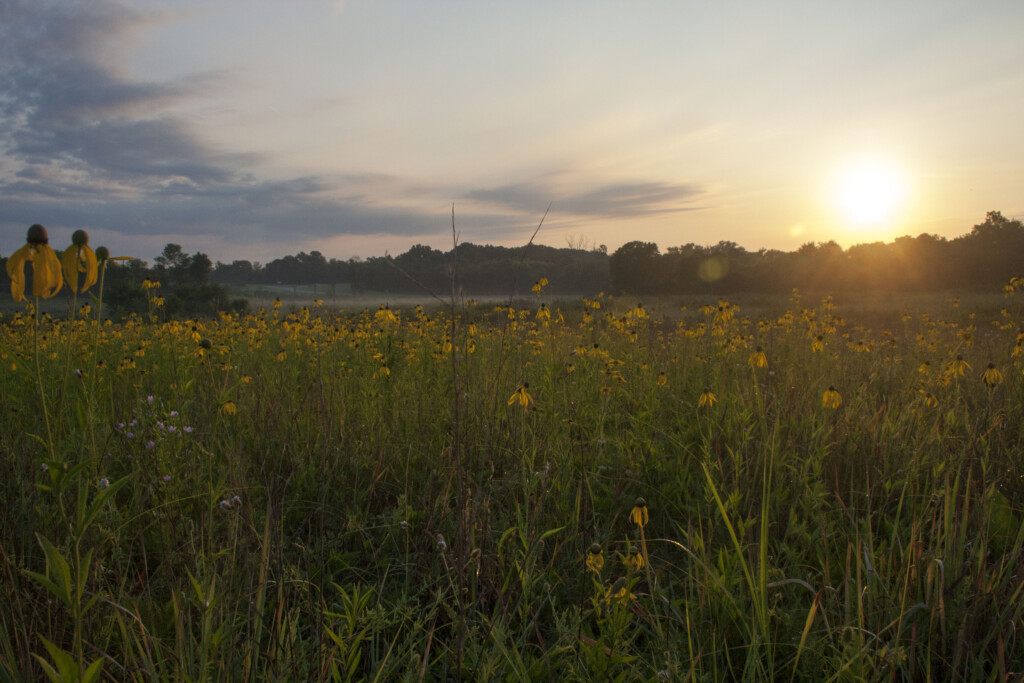
There are no stoplights on the Natchez Trace Parkway. No commercial traffic, no billboards, no rushing. Just a two-lane road winding through forests, across rivers, and past ancient mounds and quiet hollows. Pull off at a roadside marker, and you might find yourself reading about a Chickasaw chief, a frontier inn, or a Civil War site – right where it happened. Walk a section of the Old Trace and feel the path worn down by centuries of footsteps beneath yours. The Parkway rewards the traveler who takes their time, and this July, with the whole country pausing to reflect on 250 years, there’s never been a better reason to slow down and let the road tell its story.
Four Reasons to Pull Over This July
- Emerald Mound (Milepost 10.3): One of the largest Native American ceremonial mounds, Emerald Mound covers eight acres and rises 35 feet above the surrounding landscape. Built between 1250 and 1600 A.D. by ancestors of the Natchez people, it’s a powerful reminder that the story of this land stretches far beyond 250 years. Walk its grass-covered slopes and let the scale of it sink in.
- Mount Locust (Milepost 15.5): The only surviving inn – or “stand” – on the Natchez Trace, Mount Locust brings the frontier era to life like nowhere else on the Parkway. In the early 1800s, this is where Kaintuck boatmen rested, traded stories, and prepared for the long road home. Park rangers are on hand to share the full history, including the harder truths about the enslaved people whose labor made it run. It’s one of the Parkway’s most significant historic sites.
- Colbert Ferry (Milepost 327.3): On the banks of the Tennessee River, this is where Chickasaw leader George Colbert operated a stand and ferry in the early 1800s, charging travelers – including Andrew Jackson’s troops – to cross. Today it’s a peaceful picnic spot with a boat ramp and sweeping river views, but stand here long enough, and you can almost hear the flatboats and the footsteps of history crossing the water.
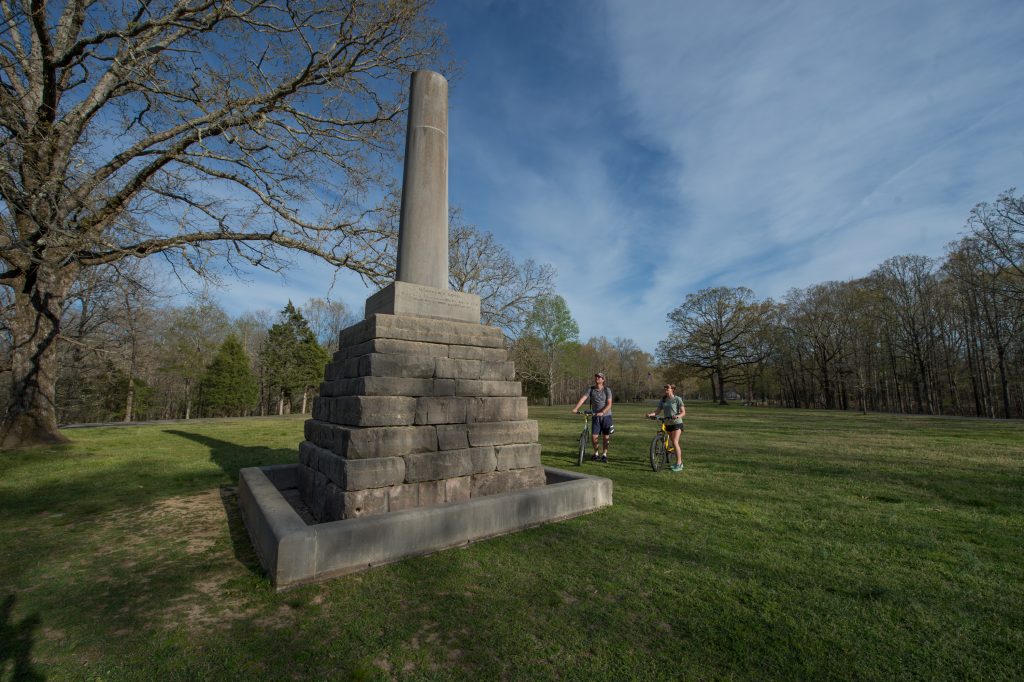
- Meriwether Lewis Monument (Milepost 385.9): As America marks its 250th anniversary, few places connect visitors to the nation’s early years more powerfully than the monument to Meriwether Lewis – explorer, hero, and one of early America’s most complex figures. Set in a quiet forested hollow in Tennessee, his gravesite and monument mark the spot where his journey ended in 1809. It’s a moving, contemplative stop that puts the full arc of American history into perspective.
The Best Way to Celebrate 250 Years? Hit the Road.
That’s the magic of the Trace. You can pull over at a roadside marker and suddenly find yourself standing where a boatman camped in 1803. You can walk a section of the original trail and feel the silence that travelers felt two centuries ago. No billboards, no stoplights, no commercial traffic – just 444 miles of forest, farmland, and sky, with 10,000 years of stories woven into every mile.
Drive a stretch. Hike a trail. Pull over and just listen. The Natchez Trace has been here for millennia – and it’ll put 250 years into perspective like nothing else can.


